
Gifts for banking Malaysia have evolved beyond branding exercises into compliance-sensitive assets that must align with governance, ESG, and conduct standards.
Private-banking relationship managers used to brief VIP gifts as a marketing line. In 2026 the same gift sits in three policy files: anti-bribery, ESG procurement, and conduct register. The recipient profile (high-net-worth, often regulator-adjacent or boardroom-level) means every detail of the gift can be queried later.
This piece is written for relationship managers, marketing leads, and procurement officers at Malaysian banks who handle the RM 300+ tier. It links up to the banking pillar and assumes the reader is already comfortable with NSRF and the BNM CCPT context.
The video below covers spent-coffee-ground composite, the material that has displaced metal and ceramic in much of the premium engraved-drinkware category. Watch before reading the data sections — material context anchors the LCA logic.
Quick Answer: A VIP client in Malaysian private banking typically holds investible assets above USD 1 million or equivalent AUM. The relationship is one-to-one with a named manager. The gift programme reflects that — single signature item, engraved, presented by the manager.
Most private-banking and priority-banking franchises in Malaysia segment by AUM and product holdings. The VIP gifting tier sits above the affluent and priority bands, where unit-cost ceilings stretch from RM 300 to RM 500 (and occasionally to RM 800 for once-yearly client-summit pieces). Bursa-listed banks now disclose Scope 3 procurement against the NSRF schedule, which means VIP gifting line items are visible inside the audit pack.
The recipient profile is concentrated and visible. A poorly-judged RM 350 gift produces three sets of consequences: client-side disappointment, internal compliance review, and external chatter at industry events. The premium tier is where small mistakes get loud, and the loud version usually surfaces in a relationship manager’s quarterly debrief or in a conduct register flag.
Quick Answer: A single high-quality engraved item retains brand visibility for years; a five-piece set rotates filler items out of use within months. Recipients keep one signature object on the desk; the rest end up given away or stored.
VIP recipients sit in three- or four-touchpoint annual cycles (year-end, festive season, anniversary, summit). Across those touchpoints, useful objects accumulate. The household and office of a high-net-worth client is already crowded with tasteful corporate gifts. A five-piece set adds clutter and dilutes the brand recall the gift was meant to create.
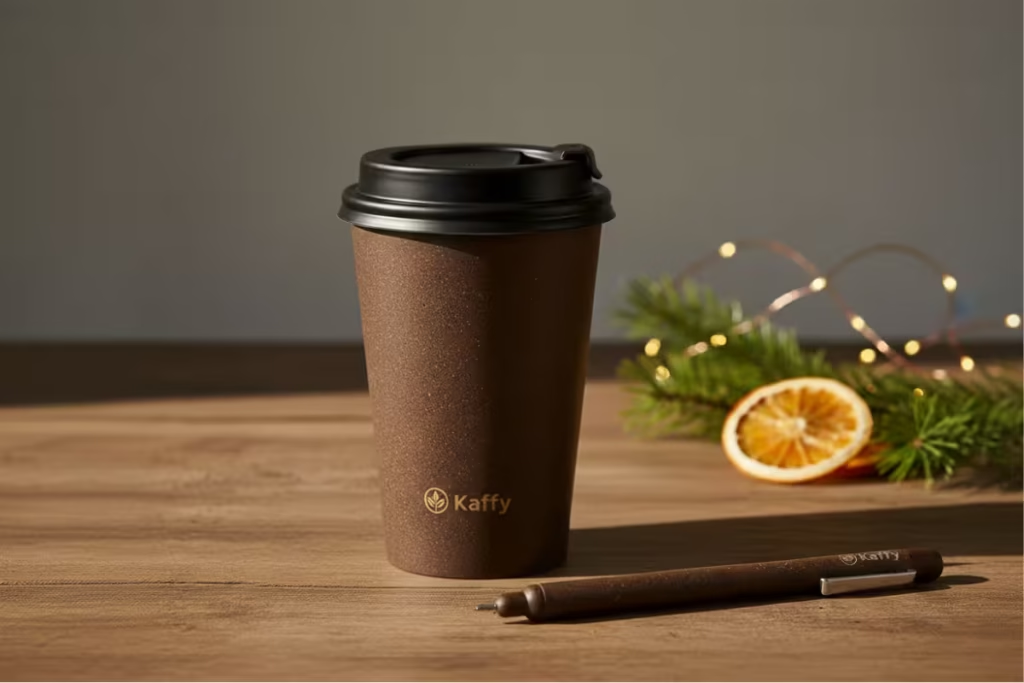
One signature object — engraved, packaged simply, delivered by hand — anchors the cycle. The rest of the budget moves to better presentation and faster lead time. The Kaffy Cup 430ml is a typical anchor in this slot: daily-use object, custom engraving, low replacement.
Quick Answer: The four materials that photograph as premium and clear ESG audit are spent coffee grounds composite, recycled glass, recycled aluminium, and FSC-certified wood. Stainless steel passes ESG but reads cool and corporate; leather and exotic woods photograph well but fail traceability.
The presentation-versus-procurement trade-off used to push relationship managers toward leather, ceramic, and exotic-wood items. Three of those are now problematic in 2026: leather (origin and tanning chemicals), exotic wood (CITES, deforestation), and virgin ceramic (energy-intensive).
The category that has filled the gap is upcycled composite drinkware. Spent coffee grounds bonded with food-grade polypropylene or biodegradable resin produces a tactile, dark-toned, naturally premium-looking object. The material specification page covers density, finish, and engraving response. Malaysia’s wider climate commitments are pushing more banks to cite material origin in their disclosure language.
Quick Answer: Laser engraving outlasts print on every sustainable substrate. Per-unit cost is similar at quantities above 50, but engraving survives 5+ years where pad-printing typically fades within 18 months. Foiling reads premium on packaging only, not on the product itself.
VIP gifting almost always carries personalisation: client name, monogram, or anniversary date. The personalisation method shapes the long-term experience of the gift more than the product itself. A faded printed logo at 18 months reflects badly on the bank.
Laser engraving on coffee-ground composite produces a slightly raised tactile mark that holds up across daily use. The technique is documented in the Kaffy production overview. Print and pad-printing remain useful for high-volume employee runs but rarely for VIP tier.
Quick Answer: The RM 500 cap is hit easily once engraving, packaging, and delivery are added. Brief in landed-cost terms. Keep handwritten notes off bank-letterhead. Log every gift in the register the same day it ships.
Five rules close most conduct-risk gaps at the VIP tier:
Quick Answer: A premium presentation box for a VIP gift in 2026 costs RM 25–60 in volumes of 100. Spending more than 15% of the total gift budget on packaging is wasteful and lowers the apparent value of the actual product.
Three packaging archetypes work for the VIP tier: a soft-touch matte box with magnetic close, a fabric-wrapped box with ribbon, and a recycled-card book-style box. All three photograph well for the relationship manager’s handover photo and survive the recipient’s desk.
The packaging itself should be ESG-defensible. Foil stamping is fine in moderation; plastic windows are not. The festive-gifts piece in this cluster covers hamper-tier packaging in more detail.
Quick Answer: Modelled estimates show top-5 commercial banks anchoring at RM 350–500 per VIP gift, mid-tier banks at RM 250–400, and Islamic banks slightly below at RM 230–380. The spread compresses upward as smaller banks match top-tier presentation to retain HNW clients.
The figures below are illustrative ranges from observed Malaysian supplier price points and competitive private-banking benchmarks.
| Bank cohort | Low | Median | High |
|---|---|---|---|
| Top-5 commercial (private banking arm) | RM 350 | RM 420 | RM 500 |
| Mid-tier commercial / priority banking | RM 250 | RM 320 | RM 400 |
| Islamic banks (HNW segment) | RM 230 | RM 300 | RM 380 |
| Foreign-licensed onshore (HNW) | RM 380 | RM 450 | RM 600 |
| Boutique investment / advisory | RM 300 | RM 380 | RM 450 |
Source: Modelled by Kaffy Editorial from observed Malaysian supplier pricing (2025–2026) and regional ESG-gifting market analysis. Illustrative scenario.
Quick Answer: Spent coffee grounds composite leads on footprint and presentation-quality, recycled aluminium leads on durability, and FSC wood leads on tactile premium feel. Each has distinct strengths; pick by recipient profile.
The comparison below is aggregated indicative figures from public LCA literature, framed for VIP-tier gift selection.
| Material | Footprint (kg CO₂e/kg) | Lifespan | Engraving |
|---|---|---|---|
| Spent coffee grounds composite | ~0.5 | 3–5 years | Excellent |
| Recycled aluminium | ~1.8 | 5–10 years | Excellent |
| FSC-certified wood | ~0.6 | 5–8 years | Very good |
| Recycled glass | ~0.9 | 3–6 years | Limited (sandblast) |
| Stainless steel | ~6.0 | 5–10 years | Very good |
| Vegetable-tanned leather | ~12.0 | 5–10 years | Hot foil |
Source: Aggregated by Kaffy Editorial from public LCA literature including peer-reviewed work on spent coffee grounds valorisation. For procurement compliance, request supplier-specific LCAs.
Quick Answer: A VIP-tier engraved order in volumes of 50–200 takes 4–6 weeks from briefing approval. Festive season pushes this to 6–9 weeks. Briefing 8 weeks ahead is the minimum that holds quality across the run.
Common delays cluster around three points: artwork sign-off (the slowest step in most banks), proofing rounds (one is normal, three signals the brief was unclear), and presentation-box production (often a separate vendor). Build slack into the artwork phase, not the production phase.
| Stage | Standard (weeks) | Festive peak (weeks) |
|---|---|---|
| Brief sign-off & artwork | 1.0 | 1.5 |
| Proof & client approval round | 0.5 | 1.0 |
| Engraving & finishing | 1.5 | 2.5 |
| Presentation box & assembly | 1.0 | 2.0 |
| Delivery & QC | 0.5 | 1.0 |
| Total (briefing → delivery) | 4.5 | 8.0 |
Source: Modelled by Kaffy Editorial from observed Malaysian supplier production cycles, 2025–2026. Illustrative scenario.
Quick Answer: Modelled projections show sustainable VIP-tier banking gifts rising from roughly 40% of programme spend in 2024 to over 85% by 2030. The shift is faster than any other recipient tier because reputation cost dominates VIP gifting decisions.
The trajectory below combines NSRF Phase 2, BNM CCPT, and the reputation-weighting that VIP-tier programmes apply.
| Year | Sustainable share | Bar |
|---|---|---|
| 2024 | ~40% | |
| 2025 | ~52% | |
| 2026 | ~62% | |
| 2027 | ~72% | |
| 2028 | ~78% | |
| 2029 | ~82% | |
| 2030 | ~86% |
Source: Modelled by Kaffy Editorial. Anchored to NSRF phased adoption and Malaysia’s net-zero 2050 commitment. Illustrative scenario.
Quick Answer: Four occasions absorb most VIP gift spend: year-end thanks, relationship anniversaries, client summits, and service-recovery apology. Each has a distinct tone — gift category should follow.
Match the gift to the moment:
Quick Answer: VIP gift ROI is measured in retention rate, AUM growth from named relationships, ESG documentation completeness, and sentiment captured in the relationship-manager call notes. Hard pure-revenue ROI is misleading at this tier.
VIP gifting is one component of a multi-touchpoint relationship investment. Attributing AUM growth to a single RM 400 gift is rarely defensible. The dashboard procurement and private-banking teams co-own tracks four softer indicators — retention rate, sentiment captured in the relationship manager’s call notes, ESG documentation completeness, and conduct-clean register record. The banking pillar covers the four-axis dashboard in more depth.
The right way to defend the spend in front of the bank’s CFO or audit committee is to show all four axes moving in the right direction. A standalone retention number invites questions; the four-axis story moves the conversation past the unit-cost line.
Most banks set the cap at RM 500 for private-banking VIPs, with the bank’s Compliance team approving any over-cap exception case-by-case. Foreign-licensed banks sometimes run higher caps (RM 600–800) for once-yearly summit pieces. The cap applies inclusive of engraving, packaging, and delivery.
No. Regulators sit under a tighter cap (typically RM 100–200) and a separate disclosure rule. Run a parallel gift for regulators that’s smaller and visibly different. Mixing regulator and VIP gifts on the same brief is a common compliance flag.
Five to seven business days for a single piece on coffee-ground composite with simple engraving, assuming pre-approved artwork. New artwork pushes it to two weeks. Emergency runs cost 30–50% more in supplier overtime fees.
Yes. The material has a dark, matte, naturally premium finish that engraves cleanly. The texture differentiates it from plastic and ceramic. Most relationship managers find it photographs as well as ceramic and better than printed metal.
Most VIP-tier programmes lean toward recipient monogram with a small discreet bank emblem on the underside. A prominent bank logo on a desk object reads as advertising and lowers the perceived gift value.
The strongest VIP gift programmes in Malaysian banking in 2026 look more disciplined than their 2022 predecessors. One signature object. Engraved, not printed. Packaging that doesn’t dominate. ESG documentation on file the day the order ships. The supplier you brief is the supplier who can produce all four — and the Kaffy Cup 340ml sits cleanly in this category.
Briefing a VIP gift run for your private-banking franchise? Contact Kaffy for a procurement-ready quote on engraved coffee-ground composite drinkware with a one-page ESG fact sheet on request. Or browse the catalogue.